The Dawn of Agentic CAE: AI-driven Design for Manufacturing in Injection Moulding
From manual iteration to intelligent orchestration: How autonomous workflows amplify engineering expertise and unlock the next era of manufacturing innovation.
In the near future, agentic AI automation and Large Engineering Models (LEMs) will converge to reshape CAE workflows from the ground up. Design for manufacturing is about to change - not incrementally, but fundamentally - not just in plastic injection moulding. By developing the first LEM for plastic injection moulding, SIMCON and EMMI AI are collaborating to create the technical foundation that unlocks this new paradigm.
Why Now
Classical trial-and-error simulation workflows are inefficient.
Few domains have more friction than simulation-driven design in injection moulding. Even today, many simulation experts still run individual simulations one by one, observe results, make adjustments, rinse and repeat. Our research shows that most people explore between 5-20 simulation variants – which is not a whole lot, and leaves large parts of the solution space unexplored. The rate of learning is limited by the slow rate and small number of observations. Because this process is run as a manual, labor-intensive workflow, it takes a long time, and engineers will pragmatically accept “good-enough” solutions instead of truly optimal ones. While design of experiments methodology can already parallelize part of the exploration phase for alternative solutions, the compute intensity of classical numerical simulation solvers makes it impractical and expensive to run very large numbers (1000+) of observations, which makes it hard to observe nonlinear impacts of changed settings.
We believe that this workflow is going to be replaced in the near future, because two developments are coming together: Agentic AI and Large Engineering Models.
Agentic AI Is Arriving in Engineering
Agentic AI systems that accept a goal, plan a sequence of actions, call tools, interpret results, and iterate on their own are no longer a research concept. They are already production infrastructure in software engineering, and they are pushing into every domain where complex, multi-step workflows create friction.
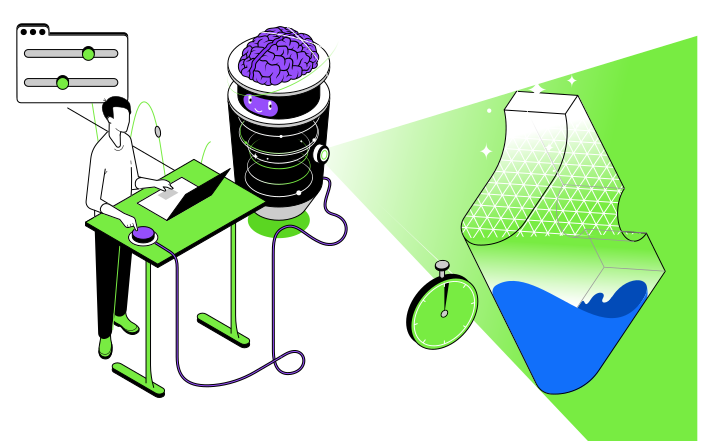
Picture an agent that takes a high-level objective - minimize warpage while maintaining fill balance under cost constraints - and orchestrates the full design exploration: setup, simulation, evaluation, next iteration. The building blocks exist today: large language models (LLMs) for reasoning, tool-calling protocols, cloud compute, CAD and CAE APIs. The question is no longer whether this will happen, but how quickly companies will be able to reorganize and adopt these methods into reliable, applied workflows.
More of the workflow will shift away from operating your simulation engine through a GUI. The agent will do this for you. Engineers will focus more on orchestrating the agentic work, evaluating, challenging and discussing results, and aligning decisionmaking with other stakeholders.
There is a catch, though. The LLMs that power agentic AI are general-purpose reasoners. They cannot predict physics at manufacturing-grade fidelity. And accuracy is paramount: hallucinations in physical predictions could have catastrophic consequences.
So, to bring high-fidelity physics into the workflow, agents will make use of specialized, domain-specific simulation tools.
An Agent Is Only as Fast as Its Slowest Tool
An AI agent uses an LLM to plan a complex workflow in seconds, and calls tools for specialized subtasks. But when an agent calls a classical numerical solver that takes four hours per design iteration, the speed and compute cost bottleneck remains - it just gets a fancier wrapper. Automating the orchestration of a slow process is not the same as building a fundamentally new capability. The fact is, classical solvers are too compute-intensive for rapid large-scale iteration.
True transformation happens when both things change at once: the workflow becomes automated and the simulation tool that the agent uses becomes radically faster. What is needed is a fundamentally different class of model.

Large Engineering Models: The Missing Piece
Enter Large Engineering Models (LEMs)
LEMs are domain-specific transformer architectures trained to predict physical behavior directly from engineering inputs - geometry, material properties, process parameters. Building them requires deep domain expertise and advanced machine learning capability working hand in hand. They are purpose-built for the physics, geometry, and complexity of a specific engineering domain.
In the past 2 years, we have invested heavily to build Cadmould’s new AI Solver - the first LEM for plastic injection moulding.
Our research shows that it can deliver the same high-fidelity results as our classical numerical solver - at up to 1,000× the speed. The heavy compute cost is incurred during training, not at inference. The workflows of the future will combine LLMs and LEMs. LLMs to plan and orchestrate; LEMs to predict the physics. Complementary capabilities on shared infrastructure. Both are GPU-native.
This means that instead of running 5-20 simulations over night, now you can run 5,000-20,000. Suddenly, questions that were previously computationally prohibitive to explore become accessible – even automatable. Design spaces that were never explored become explorable. Nonlinear effects become analyzable. Combinatorially challenging issues such as how many injection gates to use and where to put them, the timing of cascadic injection, the geometric variation of cooling channels, etc. become, for the first time, thoroughly explorable, and hence optimizable.
What Changes
When simulation preprocessing and postprocessing become automated due to agents, and simulation execution becomes close to instantaneous due to LEMs, the role of simulation in product development shifts in ways that ripple across the entire value chain.
Much larger search spaces
Today, engineers tend to explore alternative designs one by one, often 20 or fewer variants. Now imagine if instead you could run tens of thousands of simulations overnight, at comparable compute cost. The chances of finding a superior needle-in-a-haystack solution increase dramatically. Finally, you can have the computer automatically explore combinatorially daunting design variables such as the number, location and timing of gates. The scope of what you can truly optimize increases dramatically.
Simulation moves deeper into design
Today, simulation is a step that often happens after the fundamental design is already largely done. When results arrive in seconds, simulation can deliver near-real-time feedback during initial design. This leads to better-informed early decisionmaking. The familiar iteration between designer and mold engineer - send the model, wait for analysis, create a report, negotiate changes, rinse and repeat - compresses dramatically, or disappears entirely.
Institutional knowledge stays - and compounds
A generation of senior engineers is retiring. Fewer plastics engineers are entering the labor force. This results in a loss of institutional knowledge and experience that is impossible to compensate with legacy workflows. Fewer people will need to achieve more in less time. Agentic LEM systems can be a part of the solution. They can automate routine tasks - drawing on simulation history, material databases, and design guidelines – and can codify institutional knowledge before it walks out the door. And as they digitize what was previously scattered across the organization, they build the data foundation that feeds LEMs, making them more capable over time.
First movers set the pace
When a competitor can rapidly test tens of thousands of design variants in a single day before committing to steel, they compress timelines, reduce scrap, and bring better products to market faster. That advantage compounds: every design cycle generates data; more data improves the models; better models push the next cycle further. Companies that start building this flywheel now will not just move faster - they will accelerate while others are still catching up.
Where We Stand
SIMCON has been building injection moulding simulation software for over thirty years. We have proven, feature-complete, industrial-grade accuracy classical simulation technology. And in collaboration with Emmi AI, specialists in LEM architecture and training, we have used our deep domain expertise to develop a Large Engineering Model, trained on SIMCON's proprietary data. Early benchmarks show speedups of 500–1,000× at comparable accuracy for standard filling scenarios. With every training run, model scope and capability evolve and improve.
We see the convergence of agentic workflow automation, domain-specific Large Engineering Models, and a good data strategy as the foundation for what comes next. The orchestration, the speed, and the physical ground truth - each reinforcing the others.
We invite engineers, researchers, and technology partners to explore our research preview, available for free on our homepage, to stress-test the results, and to build with us. This is just the beginning. The tools for a new era of engineering for injection moulding are taking shape. Be the first to put them to work.
Learn more about the Cadmould AI Solver
Try the Cadmould AI Solver
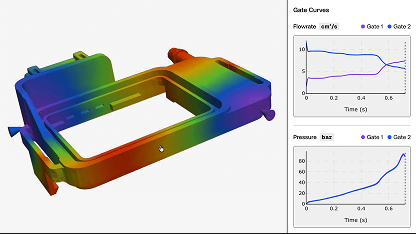
Run the Cadmould AI Solver directly in your browser to visualize filling, pressure, and shear rates in seconds. No installation required.
Explore Benchmark Geometries
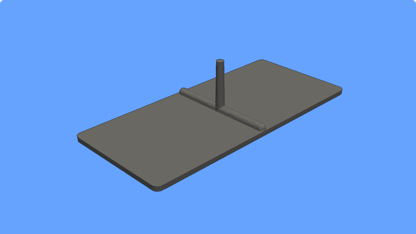
See how the engine generalizes complex, unseen topologies. Review the validation cases used to prove the model's accuracy.
AI Solver Partner Program
Join the Cadmould AI Solver Partner Program to unlock custom geometries and get access to the latest features.
Questions about the Cadmould AI Solver?
We are ready to answer them
The Cadmould AI Solver represents the cutting edge of speed, but you might have immediate production needs today. Whether you are curious about joining the Partner Program or need the proven, high-fidelity validation of Cadmould Flex, let's discuss the right path for your engineering team.