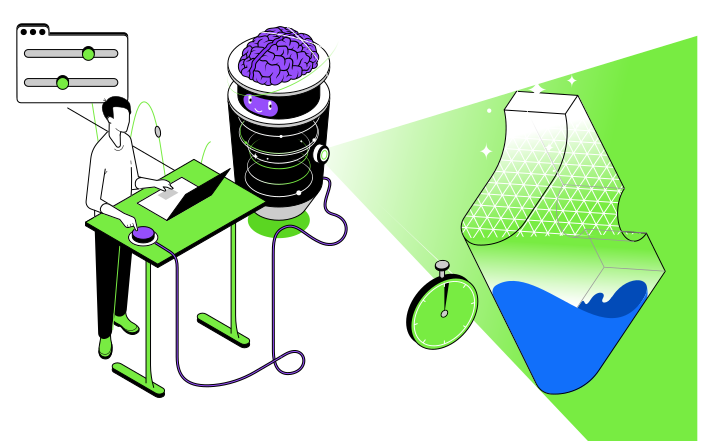
Simulating at up to 1000× the speed of conventional solvers
Injection moulding simulation is a tightly coupled multiphysics problem. Molten polymer flows through intricate geometries, exchanges heat with mould boundaries, and propagates under pressure through varying cross-sections. Accurately modelling these dynamics requires resolving the interdependence of geometry, material rheology, and process conditions across space and time.
For decades, finite-element and finite-volume solvers have been the only option. They deliver established accuracy - but at significant computational cost. A single simulation run can take hours and a full design-of-experiments study may span days. This compute intensity creates a fundamental bottleneck: it restricts how many variants are evaluated, which in turn constrains optimization. This results in engineering solutions that are just “good enough”, with many potential improvements left unexplored.
Today, we present the first Large Engineering Model for plastic injection moulding - a pre-trained transformer model that learns generalizable physics from large-scale simulation data to replace conventional solvers with real-time, physics-accurate predictions. Working with our partners at EMMI AI, we have taught this model to predict the physics of plastic injection moulding - at fidelity comparable to classical solvers, but up to three orders of magnitude (1000×) faster.
The research preview we are publishing today covers the filling stage - the propagation of the melt front through the cavity - and predicts full spatiotemporal fields: fill progression, pressure, temperature, and shear rate. The model is work in progress and we are expanding its capabilities every day. Following the well-known scaling laws, its fidelity and scope expand with the training data and compute deployed. We will release more model versions in the future, so stay tuned.
In addition to superior speed, the new engine has useful novel properties, such as full differentiability, native GPU parallelism, and resolution-flexible output. These capabilities complement our classical solver to open up entirely new workflows that were previously either computationally prohibitive or outright impossible, such as near-realtime feedback to design changes, gradient-based optimization methods, and practical integration into deeply automated agentic design-for-manufacturing workflows.
Methodology
Building a neural solver for injection moulding is not a straightforward supervised learning problem. Three intertwined challenges make naive approaches fail - and each has shaped the design of Cadmould’s AI Solver.
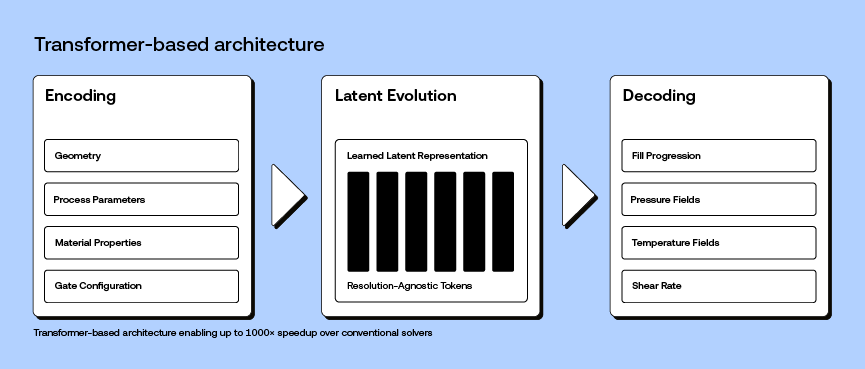
Figure 1: Transformer-based architecture enabling up to 1000x speedup over conventional solvers.
Encoding geometric diversity: Industrial parts range from planar consumer goods to complex housings with thin walls, ribs, and undercuts. Any viable model must generalize across this topological diversity without relying on fixed mesh topologies or input resolutions. Cadmould’s AI Solver addresses this through a resolution-agnostic encoding stage: the input geometry, gate definitions, material properties, and process parameters are transformed into a compact internal representation that uniformly captures both simple benchmark parts and large industrial geometries. The encoding is robust against differences in mesh density, boundary conditions, and feature complexity.
Resolving coupled physics: The filling process involves interacting transport phenomena - mass, momentum, and energy - governed by temperature-dependent viscosity and thermal boundary conditions. These interactions span scales: from macroscopic flow patterns down to local effects like hesitation at thin sections or race-tracking in regions of variable thickness. Cadmould’s AI Solver evolves the physical state within a learned latent space optimized for computational efficiency. The training objectives enforce not only stepwise accuracy but long-horizon stability, reflecting the nonlinear evolution of thermomechanical fields under varying injection parameters.
Predicting temporal evolution without drift: The system is inherently dynamic. Errors in early timesteps can compound, causing predictions to diverge from physical behaviour over the fill cycle. To counteract this, Cadmould’s AI Solver utilizes supervised training on high-fidelity data, densely sampled from a numerical solver. By penalizing predictive deviations at every individual timestep, the model is guided toward trajectory consistency, ensuring that long-term simulations remain anchored to physical laws.
The underlying architecture follows a Transformer-based design that operates in a compressed latent space, enabling the model to scale to complex industrial geometries while maintaining fast inference. At the decoding stage, physical fields - fill fraction, pressure, temperature, shear rate - are predicted at user-specified spatiotemporal coordinates. The same model supports both rapid low-resolution screening and detailed high-resolution field computation. Importantly, the entire pipeline is fully differentiable - a property we return to below.
Training
Cadmould’s AI Solver is trained on proprietary datasets built by our plastics and machine learning engineers, and performance is validated against production-grade numerical solvers. The training corpus spans synthetic geometry families and real industrial parts, systematically covering gate configurations, process settings (flow rates, mould temperatures), and diverse polymer material behaviours. Controlled perturbations in geometry and process parameters are introduced during training to enforce physically consistent and stable responses to engineering changes - such as modifying gate locations or adjusting wall thickness.
The current data set consists of hundreds of terabytes of injection moulding simulations. The research preview has been trained on a subset of this data and we are still actively extending the data set as we progress in our model development.
Data privacy by design
A common concern with neural models is data leakage: can the model reproduce proprietary information from its training data? This concern is shaped by experience with generative models that can output proprietary text, images, or code - domains where training data can appear verbatim in outputs.
Cadmould’s AI Solver is architecturally different. Its outputs are physics fields: pressure, temperature, fill fraction over space and time. Proprietary assets - part geometries, material formulations, process recipes - appear only as inputs to the model. The model cannot generate geometries or process specifications because these are simply not in its output domain. What Cadmould’s AI Solver learns is a mapping from boundary conditions to physical behaviour. High accuracy on a new part indicates that similar physics were represented during training - not that any particular geometry was memorized.
Results
We evaluated the research preview of Cadmould’s AI Solver against production-grade numerical solvers on held-out geometries spanning simple consumer parts to complex industrial components.
Computational speed
Across our entire test suite the research preview model achieves typical speedups of 500 - 1000× compared to conventional finite-element simulation. Specific speedup varies strongly with mesh resolution, material complexity, part geometry, and compute hardware. However, where the computation time for numerical solutions varied from minutes to hours the AI Solver never took more than a few seconds.
For this benchmark, numerical solver runs were performed on our HPC cluster using two AMD EPYC 9J14 CPUs per simulation; Cadmould’s AI Solver predictions were generated on a single NVIDIA A100 GPU. However, the model is compatible with current and next-generation GPU architectures and was also trained on NVIDIA H100 hardware.
Overall performance
The model performs robustly across diverse prediction targets, i.e. gate-level and nodal field predictions, yielding predominantly single-digit relative errors, alongside localized errors in the double-digit range.
While most predictions are highly accurate, complex geometric features and demanding configurations can still induce elevated localized errors. These phenomena are detailed below through illustrative examples. To mitigate these current limitations, future iterations of the model are in active development. A primary focus of this ongoing work is significantly scaling up the training dataset to specifically target demanding edge cases, ensuring that intricate geometries and extreme configurations are accurately represented and resolved.
We emphasize again that the provided interactive demo serves as a research preview; model capacity is actively being scaled in tandem with expanded datasets.
All results shown from this point forward are out-of-distribution: the model has never seen these geometries during training. For each test case, we compare predictions across four physical fields - fill progression, pressure, temperature, and shear rate - alongside maps of the relative error.
Specific example on a real industry part
We examine a single part under two different configurations to illustrate how predictions behave in practice. The pump housing geometry - kindly provided by Richter Werkzeugbau GmbH - contains pronounced wall thickness transitions between the outer walls, thin ribs, and locally thickened rib junctions. These thickness variations create strong differences in local flow resistance and melt velocity, leading to characteristic non-uniform filling behaviour. The two configurations are drawn from a benchmark dataset and differ in material, randomized gate configuration, and process parameters. The model has not seen this geometry in training.
Single-gate configuration (Figure 2): In this configuration - a single gate with one polymer and associated process settings - predictions are nearly indistinguishable from solver output. Fill progression, pressure distribution, temperature fields, and shear rate patterns align closely across the entire fill cycle. Relative errors remain below 5% throughout most of the part, with error maps showing only faint residual differences. This level of agreement demonstrates that the research preview captures the core physics of melt propagation, pressure buildup, and thermal exchange with high fidelity.
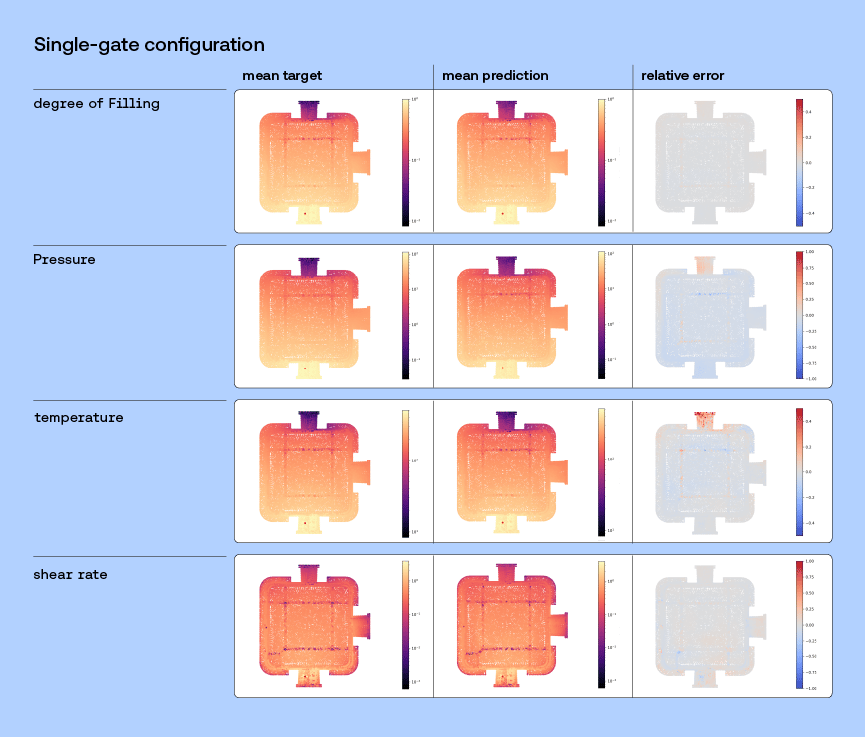
Figure 2: Single-gate configuration for a pump housing (provided by Richter Werkzeugbau GmbH). Column 1: Ground truth, Column 2: Cadmould's AI Solver, Column 3: Relative difference.
Dual-gate configuration with different material (Figure 3): In this second configuration - a different polymer, two gate locations near the interior ribs, and different thermal and flow rate settings - the gap between the research preview and the numerical solver becomes more apparent. While filling progression and shear rate remain well predicted globally, the temperature and pressure error maps reveal structured deviations in regions far from both injection points. These deviations are most pronounced in feature-dense areas, where numerous ribs and thin sections create complex local flow interactions. Notably, the overall fill pattern and global behaviour remain correct - the errors are localized rather than systemic.
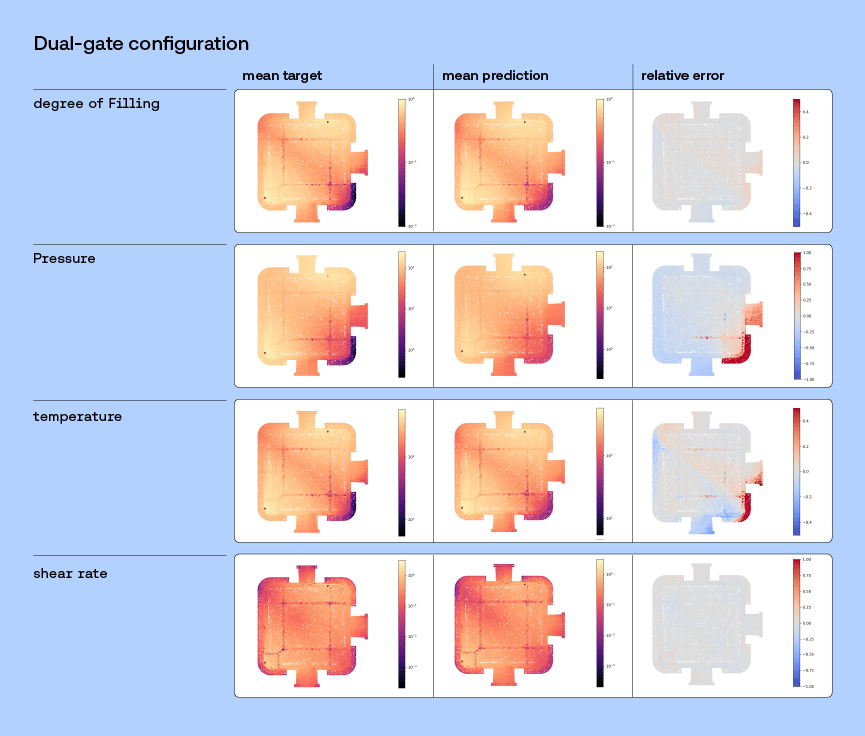
Figure 3: Dual-gate configuration with different material and process parameters for the same pump housing. Column 1: Ground truth, Column 2: Cadmould's AI Solver, Column 3: Relative difference.
More generally, we observe across our test suite that the majority of predictions fall within tight error bounds. Cases with higher localized errors tend to involve more complex flow interactions - such as multi-gate setups, different materials, or feature-dense regions - where the model has likely not yet seen sufficient training coverage. Beyond localized errors, certain geometric configurations - particularly parts with fine holes, narrow gaps, or thin ribs - can trigger known failure modes such as the melt front bypassing constrained features (discussed below), leading to substantial deviations. As with overall model performance, we expect these gaps to narrow as we scale training data and broaden regime coverage, consistent with the neural scaling behaviour observed throughout development.
Future Implications
The speedup alone changes what is practically possible. But the combination of three properties - native GPU parallelism, resolution-flexible decoding, and full differentiability - is more than an incremental improvement. Together, they create a simulation engine with fundamentally different characteristics: one that can be called thousands of times within a single optimization loop, that can return gradients rather than just outputs, and that runs natively on the same hardware as the AI systems increasingly used to orchestrate engineering workflows. This opens possibilities that have no equivalent in conventional simulation. While these capabilities are at various stages of development, they illustrate the design space that a fast, differentiable AI Solver unlocks for the injection moulding industry.
Gradient-based optimization
Classical solvers are black boxes from an optimization perspective: to find a better gate location or process window, engineers explore variants and evaluate outcomes. Differentiability reverses this logic. Because Cadmould’s AI Solver can compute gradients of outputs with respect to inputs, engineers can start from the target - e.g. quality criteria, pressure limits - and work backward toward the process settings that achieve it. Gradient-based optimization has limitations. But it shifts the question from "let me try this and see what happens" to "show me what to change to get the result I need."
Manufacturability feedback at the point of design
Simulation today enters the workflow late - after part design is largely finalized - resulting in costly DFM loops between designers and mould engineers. A simulation fast enough to run interactively and smart enough to require minimal expert configuration can short-circuit this loop entirely. With manufacturability feedback available in seconds within the design environment, part designers can validate fill behaviour, identify weld lines, or flag thin-wall risks before the geometry ever leaves their workspace - fewer iterations between silos, faster convergence on producible designs.
More broadly, a simulation engine that is fast, differentiable, and API-callable becomes a natural building block for automated engineering workflows - whether driven by optimization algorithms, design-of-experiments frameworks, or emerging AI-assisted process chains. The properties that make Cadmould’s AI Solver useful to a human engineer in an interactive loop are the same properties that make it useful as a computational service within larger automated or agentic engineering pipelines.
Closing the loop on the production floor
When a running mould produces defects, the root cause is often ambiguous - a short shot alone could justify adjusting melt temperature, mould temperature, or injection speed. Process control systems already exist on the shop floor, but they lack the physical insight to identify which corrective action will be most effective. An AI solver fast enough to evaluate thousands of parameter combinations within a single production cycle - leveraging GPU parallelism - could supply exactly that insight, connecting simulation to production in a way that has not been possible before. As Cadmould's AI Solver matures and its prediction scope extends beyond filling to shrinkage and warpage, this feedback loop becomes increasingly actionable - not just diagnosing what went wrong, but recommending what to change.
Limitations, Outlook
Current scope
Cadmould’s AI Solver is a rapid method for executing injection moulding simulation, not a replacement for engineering judgment. Its accuracy and scope are bounded by the regime coverage of its training data. It is best suited for design iteration, process optimization, and sensitivity studies - contexts where fast feedback outweighs absolute numerical precision. For high-consequence design decisions or regulatory validation, AI Solver predictions are a fast way to narrow down the search space. Candidate results should then be cross-checked with conventional solvers or experimental measurements.
Active development areas
Freeze temperature enforcement: The research preview does not yet consistently enforce freeze behaviour. For some cases where the numerical solver predicts flow hesitation due to solidification, the model may continue to predict melt propagation into regions that should be frozen. This is most evident in thin-wall sections with rapid cooling. Refinements targeting this behaviour are in development.
Fine-feature spatial resolution: Small holes, narrow gaps, and fine ribs can be bypassed by the predicted melt front. Rather than accurately resolving hesitation or blockage at these features, the model sometimes allows flow to "jump" across geometrically constrained regions. We expect significant improvement here as we scale training data and refine the spatial encoding, consistent with observed neural scaling laws.
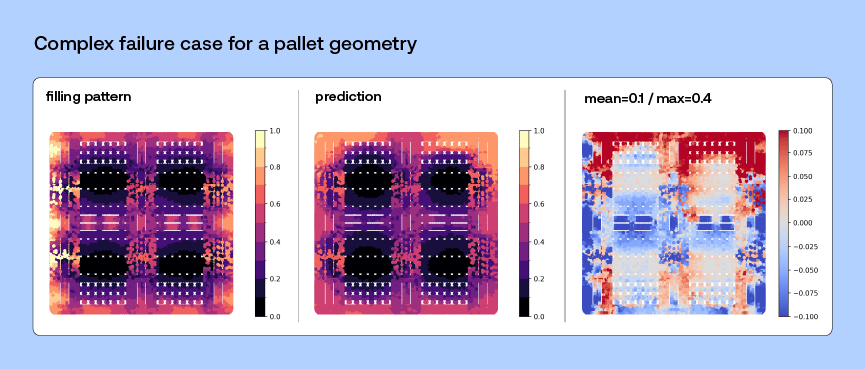
Figure 4: Complex failure case for a pallet geometry. Column 1: Ground truth, Column 2: Cadmould’s AI Solver results, Column 3: Relative Difference
Interactive research preview artefacts:The publicly available live interactive research preview is a powerful demonstration of the model's current capabilities and we are actively tracking remaining issues as we continue to improve Cadmould’s AI solver. Occasionally, the simulation adopts a too conservative completion threshold, halting just before the final filling step and reporting an incomplete fill, even when a complete fill is imminent. Users may also notice minor, transient visual anomalies, such as small air bubbles briefly appearing in localized areas.
As with general model performance, we expect significant improvement in freezing behaviour and learned spatial encoding resolution as we scale training data in accordance with observed neural scaling laws.
Outlook
The current research preview demonstrates reliable predictions for the filling stage. Development is underway to extend Cadmould’s AI Solver to shrinkage and warpage prediction - enabling ultra-rapid assessment of dimensional stability and part quality. Architectural refinements targeting the development areas described above are progressing. We expect the observed scaling behaviour to continue: more data, broader regime coverage, and improved spatial encoding will progressively close the gap to conventional solvers.
Try it yourself
Interactive research preview: On our website we provide a live web interface where users can select from example geometries that the model has not seen in training (including the pump housing shown above). Users can modify gate locations, adjust material properties and process parameters, and run Cadmould’s AI Solver simulations in real time. Results can be viewed interactively in the browser, enabling hands-on exploration of model behaviour across the parameter space.
Benchmark dataset: We also provide a structured evaluation set containing a reference geometry with full specification of materials, process conditions, Cadmould’s AI Solver solutions and numeric solver-generated ground truth. For users of our commercial solver software, we provide ready-to-run project files for direct side-by-side comparison.
Get Involved
Join the Community
We invite researchers, engineers, and industry practitioners to stress-test Cadmould’s AI Solver, to identify failure modes, and to share feedback. This collaborative validation will directly inform the next phase of development and help establish shared benchmarks for neural physics solvers in injection moulding simulation.
Early Access Partner Program
For companies interested in early access to new capabilities, co-validation on proprietary geometries, and direct input on product development, we offer a dedicated partnership program. Partners gain priority access to upcoming AI solver features, collaborate on benchmarking against their own parts and workflows, and help shape the product roadmap. If this is relevant for your organization, reach out to our team.
Cadmould’s AI Solver is developed by SIMCON in collaboration with Emmi AI, combining SIMCON's deep domain expertise and rich data on plastic injection moulding simulation with Emmi AI's expertise in scalable LEM architecture and training.
Learn more about the Cadmould AI Solver
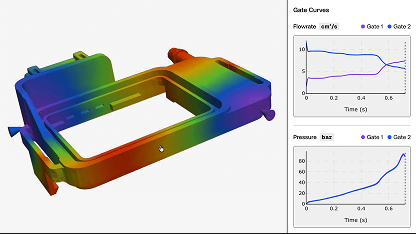
Try the Cadmould AI Solver
Run the Cadmould AI Solver directly in your browser to visualize filling, pressure, and shear rates in seconds. No installation required.
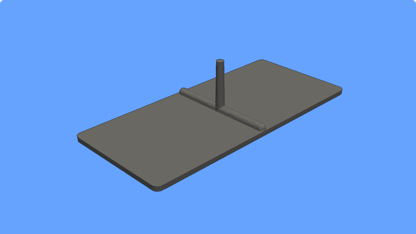
Explore Benchmark Geometries
See how the engine generalizes complex, unseen topologies. Review the validation cases used to prove the model's accuracy.

AI Solver Partner Program
Join the Cadmould AI Solver Partner Program to unlock custom geometries and get access to the latest features.
Questions about the Cadmould AI Solver?
We are ready to answer them
The Cadmould AI Solver represents the cutting edge of speed, but you might have immediate production needs today. Whether you are curious about joining the Partner Program or need the proven, high-fidelity validation of Cadmould Flex, let's discuss the right path for your engineering team.